

Workers and community advocates protest California Public Utilities Commission’s latest autonomous vehicle rules
Gig rideshare drivers, public transit workers, and community advocates rally in San Francisco, demanding a meaningful say in how autonomous vehicles expand in local communities
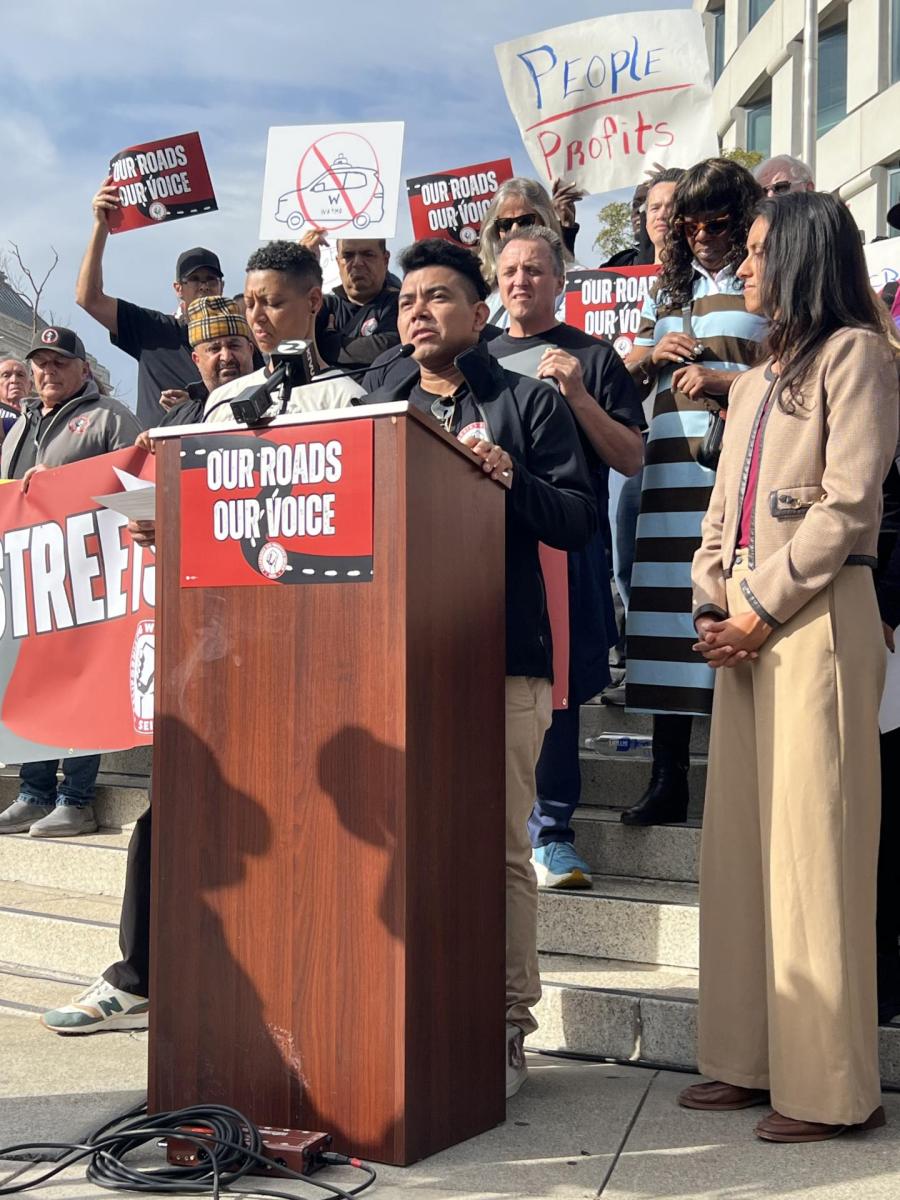
On Thursday, October 29, as the California Public Utilities Commission (CPUC) prepared to vote on its latest rules governing commercial autonomous vehicles (AVs), workers and community advocates rallied outside the Commission’s meeting to demand that local communities have a say in where, when, and how AV companies expand their operations.
Uber and Lyft drivers, public transit workers, community advocates, and elected officials are calling on the CPUC to ensure cities, counties, transportation agencies, emergency responders, workers, and residents have opportunities to weigh in before AV companies are reintroduced on their streets after safety-related incidents. They also demand greater transparency, airport-specific safety protocols, and accountability when AV operations affect public streets, public safety, and workers’ livelihoods.
OUR STREETS. OUR SAFETY. OUR SAY.
Across the state, local governments are raising concerns about the state’s approach to AV regulation and the limited authority communities have over how these vehicles operate on their streets.
The San Diego City Council unanimously adopted a resolution calling on the state to give local governments greater authority to regulate AV passenger services. Culver City and Santa Monica officials have also pursued local rules governing where AV fleets can be serviced and maintained.
These efforts reflect a common concern: local governments and workforces respond to traffic, street safety, emergency services, and community impacts, but state-level permitting can leave them with limited power over AV deployments.
“What city leaders in San Diego, Culver City, and Santa Monica are showing is that communities need a say in what happens on their own streets,” said Harvin Melendez, an LA-based Uber and Lyft driver. “We live and work on these streets, and the Commission wants to make it so that the companies can have an even bigger say than we do when more robotaxis come into our neighborhoods.”
“Cities, counties, and local workforces are left dealing with the consequences AV fleets roll out, but we have so little say in those decisions,” said Trevor Adams, a parking control officer in San Francisco. “Just look at what happened during last year’s power outage. Hundreds of Waymos stalled and blocked our streets, and our city had to deal with them blocking intersections and emergency responders.”
Under California’s current regulatory framework, the state authorizes AV passenger service, limiting a city’s ability to decide whether such services can begin or should be paused because of safety concerns.
SERIOUS AV INCIDENTS ON CALIFORNIA STREETS
Communities across California have reported incidents involving autonomous vehicles and concerns about pedestrian safety, emergency response, traffic obstruction, and local oversight.
• San Francisco, October 2023: A Cruise robotaxi fatally dragged a pedestrian approximately 20 feet after she was struck by another vehicle.
• San Francisco, 2023: The San Francisco Fire Department alleged that autonomous vehicles obstructed an ambulance responding to a pedestrian emergency. Firefighters have also raised concerns about AVs blocking streets, entering emergency areas, and driving over fire hoses.
• San Francisco, December 2025: During a citywide power outage, reports described large numbers of Waymos stopping on streets and disrupting traffic, raising concerns about emergency access and the ability to manage AV fleets during citywide disruptions.
• Santa Monica, January 2026: A Waymo vehicle struck a nine-year-old pedestrian in a school zone during morning drop-off. Federal agencies are investigating.