

Uber and Lyft drivers join freight, delivery, and San Francisco city and county workers to demand Waymo and self-driving rideshare vehicles off of city streets
Rally ahead of SF hearing demands autonomous rideshare vehicles like Waymo be taken off the road until safety, transparency, emergency coordination, and job protections are guaranteed
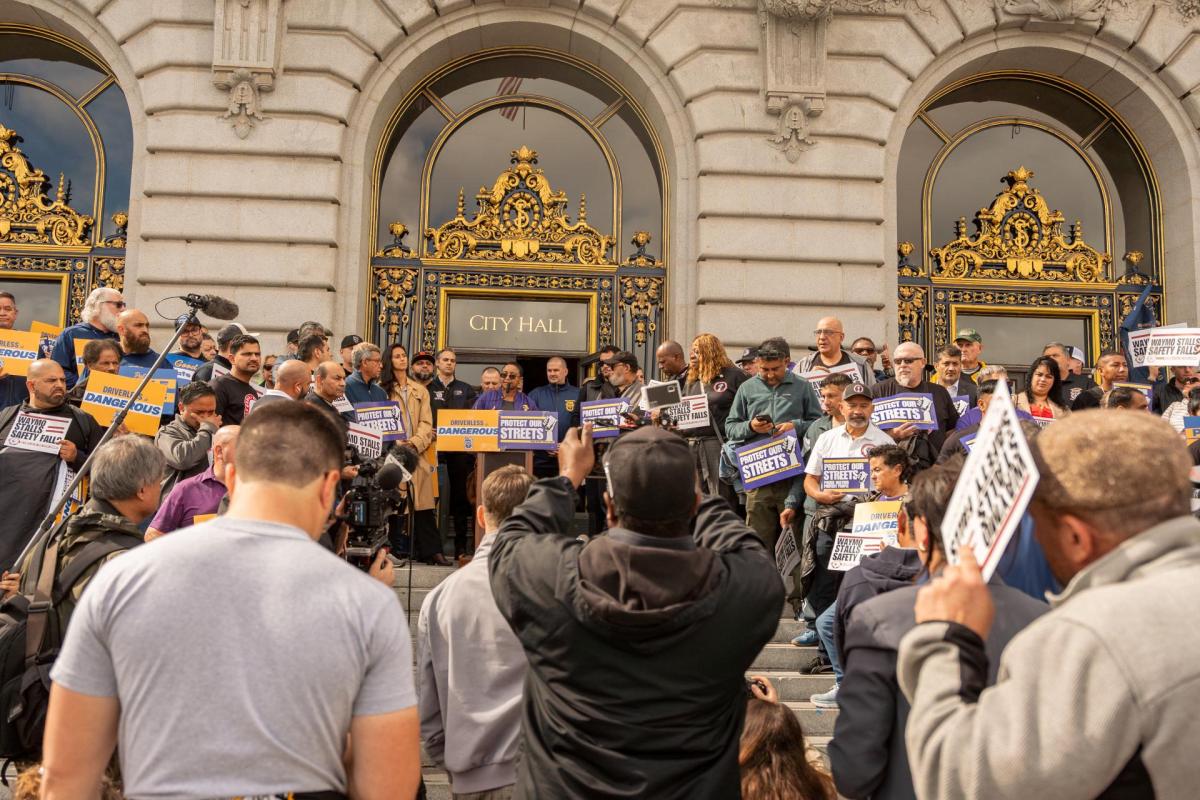
Monday, March 2, Uber and Lyft drivers united in California Gig Workers Union, along with freight and delivery members of Teamsters Joint Council 7, San Francisco Firefighters, and SEIU 1021 SF City & County members, held a rally demanding Waymos be taken off the road until public safety concerns are adequately addressed.
The rally came ahead of a public hearing at the San Francisco Board of Supervisors examining Waymo robotaxis’ system-wide shut down during the December 2025 storms. Drivers and SF workers and residents are demanding strong safeguards on automated vehicles: real oversight and support to ensure effective emergency responses, full public transparency of safety data, and meaningful involvement of workers and communities in every stage of autonomous vehicle planning and operations.
As autonomous vehicles (AVs) continue to operate on city streets, regulators risk allowing technology to outpace public safety, without real oversight or involvement from local communities. Currently there are no procedures in place for local governments to order AVs off the road in cases of emergency, with oversight further complicated by Waymo’s claims that its data on emergencies is confidential proprietary information.
Speakers at the press conference underscored how the rapid expansion of Waymos and other AI-enabled technologies are threatening livelihoods and undermining working-class communities. The number of AV companies with pending permits continues to grow, yet cities have no authority over when or how these vehicles hit public roads.
SEIU 1021 President Theresa Rutherford said, “Waymos present an inherent danger. In the medical field, there’s a term ‘golden hour.’ That’s the first 60 minutes that are the most important for saving lives. Waymos have blocked emergency vehicles and then become unresponsive. This poses a life-and-death risk to folks in San Francisco.”
Kayla Craig, daughter of SEIU 1021 San Francisco Regional Vice President Kristin Hardy, said: “My dog Leo was killed by a Waymo. Our streets are not safe. It was heartbreaking and frightening. If a Waymo cannot see a dog on the street, how can we trust Waymos with children, seniors, people with disabilities, cyclists, and pedestrians? Street safety is not just numbers in a report. It is real life. Our streets are built for people, not experiments.”
Hector Castellanos, a driver leader in the California Gig Workers Union, said: “Waymos cannot replace the human factor. We know what to do when there is an outage, when the traffic light isn’t working, when we help a passenger with a medical emergency. We need to support drivers and keep our streets safe. We need to protect jobs.”
At the moment, an estimated 30 companies hold active permits, and workers say that the lessons from Waymos’ city-wide meltdown in December 2025 should inform further expansion of the technology. Workers are calling on officials at every level of government to consider economic impacts on local communities, protect jobs, and ensure technology serves the public good, not corporate profits alone.